Retail Audit in Oman
In-store measurement of distribution, share of shelf, price, promotion and out-of-stocks across Omani trade channels, outlet by outlet.
What is a retail audit, and does Quantum Gulf Marketing run one in Oman?
A retail audit is a physical, in-store measurement of how a product range is distributed and displayed. Auditors visit a representative sample of outlets and record presence, number of facings, shelf position, price, promotional activity and out-of-stocks, outlet by outlet. Quantum Gulf Marketing has run retail audits in Oman for more than ten years across traditional and modern trade, covering FMCG food and non-food, technical consumer goods, domestic appliances, lubricants and tyres. Because we also build outlet universes, the sample reflects the Omani trade as it exists rather than a purchased list that has aged.
Audits are commissioned by brand owners and distributors who need to know whether a distribution number is real. Because Quantum Gulf Marketing also builds the outlet universes these samples are drawn from, a distribution percentage can be projected to the country rather than merely described for the sample. Categories already covered in Oman include FMCG food and non-food, technical consumer goods, domestic appliances, lubricants and tyres, across hypermarkets, mini markets, groceries, pharmacies, coffee shops and e-commerce listings.
- Method
- In-store observation and measurement at a sampled outlet frame
- Recorded
- Distribution, facings, share of shelf, price, promotion, out-of-stock
- Channels
- Modern trade, traditional trade, pharmacy, e-commerce
- Categories
- FMCG food and non-food, TCG, appliances, lubricants, tyres
- Coverage
- All 11 governorates of Oman
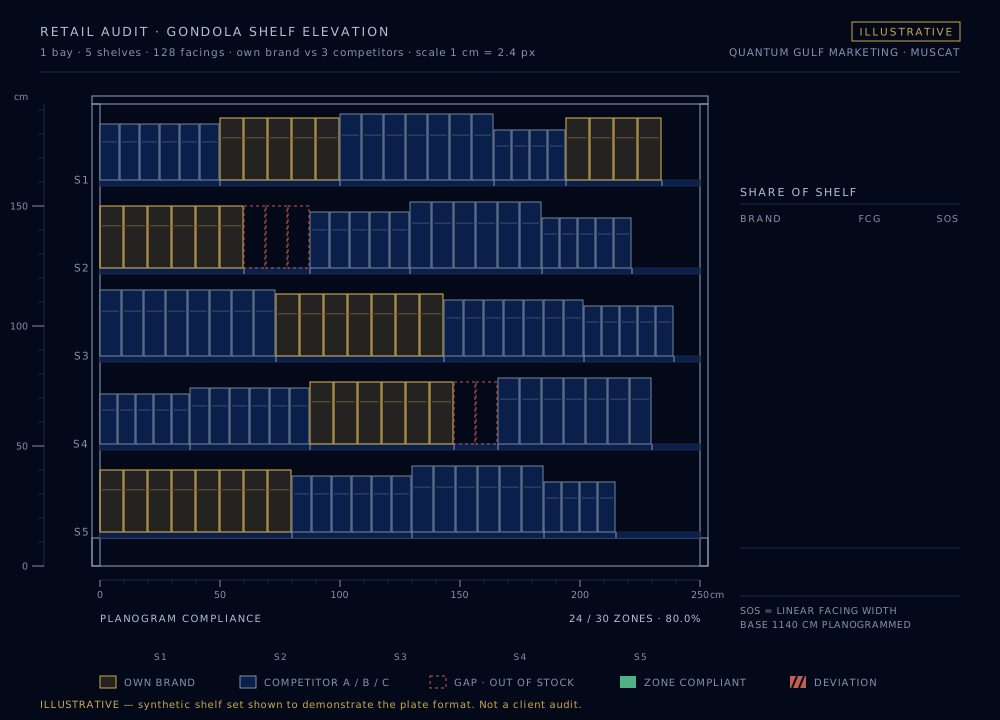
The shelf, as it stood.
Share of shelf derived from the facings actually measured, with gaps marked where the product was not there. The plate below is illustrative.
Twelve things a shelf will tell you.
The field list is fixed at design stage and does not drift between waves, because a measure that changes definition mid-programme destroys the comparison you paid for.
| Measure | What you learn |
|---|---|
| Distribution | Whether the SKU is present at all, by outlet and by channel, projected against the outlet universe rather than the sample. |
| MSL compliance | Whether every product on the must stock list for that outlet was actually on shelf, scored per outlet and per group rather than as a network average. |
| On-shelf availability | Which of your SKUs were physically present and shoppable at the moment of the visit, outlet by outlet, wave by wave. |
| Out of stock and voids | The difference between a listing that is missing entirely and a facing that is temporarily empty, and where the pattern repeats. |
| Facings and share of shelf | Facings counted rather than estimated, converted to your share of category space and compared with your share of category value. |
| Share of visibility | Total brand presence including secondary sitings, gondola ends, chillers and off-shelf displays, not only the main bay. |
| Shelf position | Level and block. Present at ankle height and present at eye level are not the same commercial outcome. |
| Planogram compliance | Scored against the planogram you supplied, not against an auditor's impression of what looked tidy. |
| Price compliance | Shelf price read from the ticket and checked against your recommended price and against competitors in the same outlet. |
| Promotion compliance | Whether the mechanic you paid for actually ran, in that outlet, inside the window it was booked for. |
| POSM and display | Whether the material went up, whether it went up correctly, and whether it was still there later in the cycle. |
| Stock condition | Damage and near-expiry flagged at the shelf, while it is still a merchandising problem rather than a returns conversation. |
| Competitor activity | New listings, price moves and space gains in your category, captured on the same visit so the comparison is same-day. |
| Photo evidence | Every claim above backed by a timestamped image, so a disputed figure can be re-checked rather than argued about. |
Image recognition is available for large repeating programmes through our Dubai partner SMRC.
From frame to finding.
Define the universe
We agree the outlet frame, by channel and governorate. Where no reliable frame exists, a census is run first.
Draw the sample
Outlets are selected to represent the trade, with the channel mix and regional spread that your category needs.
Audit in store
Trained auditors record the agreed fields at each outlet, with checks running during fieldwork rather than after it.
Report and track
Results come back as distribution, share of shelf, price and out-of-stock, comparable wave on wave because the field list never moved.
Done here, for names you know.
Retail audit work already delivered in the Sultanate.
| Client | Programme | Scale |
|---|---|---|
| GfK | Retail audit across mobile, technical consumer goods, optical, lubricants and tyres | 300 stores |
| Caltex | Planogram study in the fuel retail channel | Full country |
Client names published with permission. Sample sizes are per wave where a study ran in waves.
Common questions
What is a retail audit?
A retail audit is a physical, in-store measurement of how a product range is actually distributed and displayed. Auditors record presence, facings, shelf position, price, promotion and out-of-stocks at each outlet in a defined sample.
How is this different from sell-out data?
Sell-out data tells you what left the till. A retail audit tells you what was on the shelf and at what price when it did, which is the part you can change. The two answer different questions and are strongest together.
How often should we audit?
Most tracking programmes run monthly or quarterly. The right frequency depends on how fast your category turns and how often your competitors change price or promotion.
Which outlets do you cover?
Hypermarkets and supermarkets, mini markets, large, medium and small groceries, pharmacies, coffee shops and e-commerce listings. The channel mix is set by your category, not by a fixed template.
Do you audit price as well as availability?
Yes. Shelf price, promotional price and the mechanic behind the promotion are recorded together, because a price without its mechanic is misleading.
How do you know the sample represents Oman?
Because we build the outlet universe first. Where a reliable frame does not exist we run a census and sample from that, rather than sampling from a list of convenience.
Tell us the question.
We will tell you how to measure it.
Send us the business decision you are stuck on. You will get a straight answer on whether research can settle it, what it would take, and what it would cost.